Strain Data Sheet
RBRC02711
Strain Information | |
|---|---|
| Image | 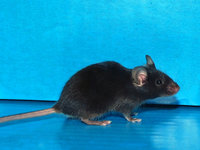 |
| BRC No. | RBRC02711 |
| Type |  |
| Species | Mus musculus |
| Strain name | B6.129S-Osmr<tm1Mtan> |
| Former Common name | Oncostatin M receptor knockout mouse, OSMR-KO |
| H-2 Haplotype | |
| ES Cell line | CCE/EK.CCE [129S/SvEv-Gpi1<c>] |
| Background strain | C57BL/6NCrSlc |
| Appearance | black [a/a B/B C/C] |
| Strain development | Developed by Dr. Minoru Tanaka in 1999. |
| Strain description | Osmr knock-out mice. Osmr, Oncostain M receptor is an alternative subunit that activated by Osm. Osm is a multifunctional cytokine that belongs to the interleukin 6 family, considered to play a role in hematopoiesis. Homozygous mutant mice are viable and fertile, but show a mild anemia and recovery delay of erythrocytes from chemically induced acute hemolysis. |
| Colony maintenance | Heterozygote x Wild-type [C57BL/6CrSlc] |
| References | Targeted disruption of oncostatin M receptor results in altered hematopoiesis. Minoru Tanaka, Yoko Hirabayashi, Takashi Sekiguchi, Tohru Inoue, Motoya Katsuki, Atsushi Miyajima Blood, 102, 3154-3162 (2003). 12855584Hepatocyte proliferation and tissue remodeling is impaired after liver injury in oncostatin M receptor knockout mice. Koji Nakamura, Hidenori Nonaka, Hiroki Saito, Minoru Tanaka, Atsushi Miyajima Hepatology, 39, 635-644 (2004). 14999682 |
Health Report | |
|---|---|
| Examination Date / Room / Rack | 2025-09-08Room:3-CRack:HSentinel mouse program 2025-06-30Room:3-CRack:HSentinel mouse program 2025-04-21Room:3-CRack:HSentinel mouse program 2025-01-20Room:3-CRack:HSentinel mouse program |
Gene | ||||||
|---|---|---|---|---|---|---|
| Gene Symbol | Gene Name | Chr. | Allele Symbol | Allele Name | Promoter | Diseases Related to This Gene |
Osmr | oncostatin M receptor | 15 | Osmr<tm1Mtan> | targeted mutation 1, Minoru Tanaka | ||
lacZ | beta-galactosidase (E. coli) | 15 | ||||
neo | neomycin resistance gene (E. coli) | 15 | herpes simplex virus thymidine kinase promoter (HSV tk promoter) | |||
Phenotype | |
|---|---|
| Phenotype annotation from literatures by Mammalian phenotype ontology | more 39 phenotypes |
| Detailed phenotype data | |
Ordering Information | |
|---|---|
| Donor DNA | herpes simplex virus thymidine kinase promoter (HSV tk promoter), E. coli neo, E. coli lacZ, mouse Osmrg genomic DNA |
| Research application | Fluorescent Proteins/lacZ System Hematological Research |
| Specific Term and Conditions | In publishing the research results obtained by use of the BIOLOGICAL RESOURCE, a citation of the following literature(s) designated by the DEPOSITOR is requested. Blood, 102, 3154-3162 (2003). Hepatology, 39, 635-644 (2004). The RECIPIENT of BIOLOGICAL RESOURCE must obtain a prior written consent on use of it from the DEVELOPER (Chiome Bioscience Inc. Email:knakamura@chiome.co.jp). |
| Depositor | Atsushi Miyajima (The University of Tokyo) |
| Strain Status |  Frozen embryos  Frozen sperm |
| Strain Availability | Recovered litters from cryopreserved sperm (2 to 4 months) Cryopreserved sperm (within 1 month) Cryopreserved embryos (within 1 month) |
| Additional Info. | Necessary documents for ordering:
Genotyping protocol -PCR- |
BRC mice in Publications |
|---|
Hermans D, Houben E, Baeten P, Slaets H, Janssens K, Hoeks C, Hosseinkhani B, Duran G, Bormans S, Gowing E, Hoornaert C, Beckers L, Fung WK, Schroten H, Ishikawa H, Fraussen J, Thoelen R, de Vries HE, Kooij G, Zandee S, Prat A, Hellings N, Broux B. Oncostatin M triggers brain inflammation by compromising blood-brain barrier integrity. Acta Neuropathol 144(2) 259-281(2022) 35666306 |
Janssens K, Maheshwari A, Van den Haute C, Baekelandt V, Stinissen P, Hendriks JJ, Slaets H, Hellings N. Oncostatin M protects against demyelination by inducing a protective microglial phenotype. Glia 63(10) 1729-37(2015) 25921393 |
Zhang X, Li J, Qin JJ, Cheng WL, Zhu X, Gong FH, She Z, Huang Z, Xia H, Li H. Oncostatin M receptor β deficiency attenuates atherogenesis by inhibiting JAK2/STAT3 signaling in macrophages. J Lipid Res 58(5) 895-906(2017) 28258089 |
Guo S, Li ZZ, Gong J, Xiang M, Zhang P, Zhao GN, Li M, Zheng A, Zhu X, Lei H, Minoru T, Li H. Oncostatin M Confers Neuroprotection against Ischemic Stroke. J Neurosci 35(34) 12047-62(2015) 26311783 |
Feng Y, Yuan Y, Xia H, Wang Z, Che Y, Hu Z, Deng J, Li F, Wu Q, Bian Z, Zhou H, Shen D, Tang Q. OSMR deficiency aggravates pressure overload-induced cardiac hypertrophy by modulating macrophages and OSM/LIFR/STAT3 signalling. J Transl Med 21(1) 290(2023) 37120549 |
Yamamura K, Uruno T, Shiraishi A, Tanaka Y, Ushijima M, Nakahara T, Watanabe M, Kido-Nakahara M, Tsuge I, Furue M, Fukui Y. The transcription factor EPAS1 links DOCK8 deficiency to atopic skin inflammation via IL-31 induction. Nat Commun 8 13946(2017) 28067314 |